Do Solar-Powered Street Furniture Work in Cold and Cloudy Weather? Technical Facts

Solar-powered street furniture is increasingly preferred in line with the sustainability goals of modern cities. However, one of the most frequently asked questions by municipalities and public institutions is: "Do solar-powered street furniture really work in cold, rainy, and cloudy weather?"
This is a very valid question, especially considering the different climate zones of Turkey and the applications in Europe.
This article will detail the technical realities , misconceptions , and actual use cases of solar-powered smart benches and other urban furniture . The content is based on Propysalford's field experience and engineering approach
1. How Do Solar-Powered Street Furniture Systems Work? Basic Technical Principles:
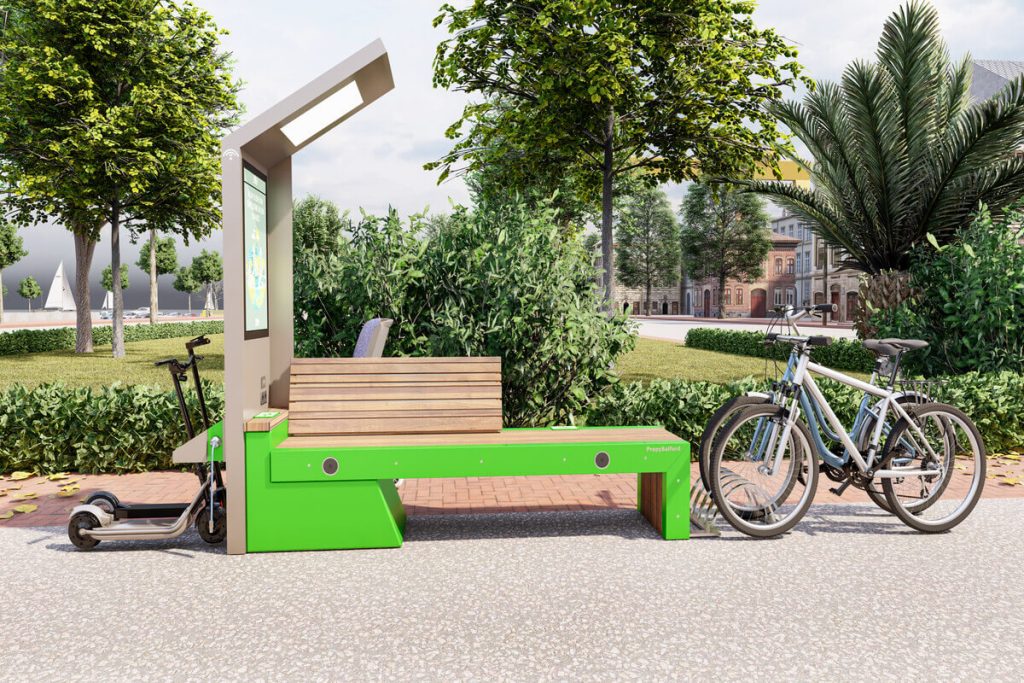
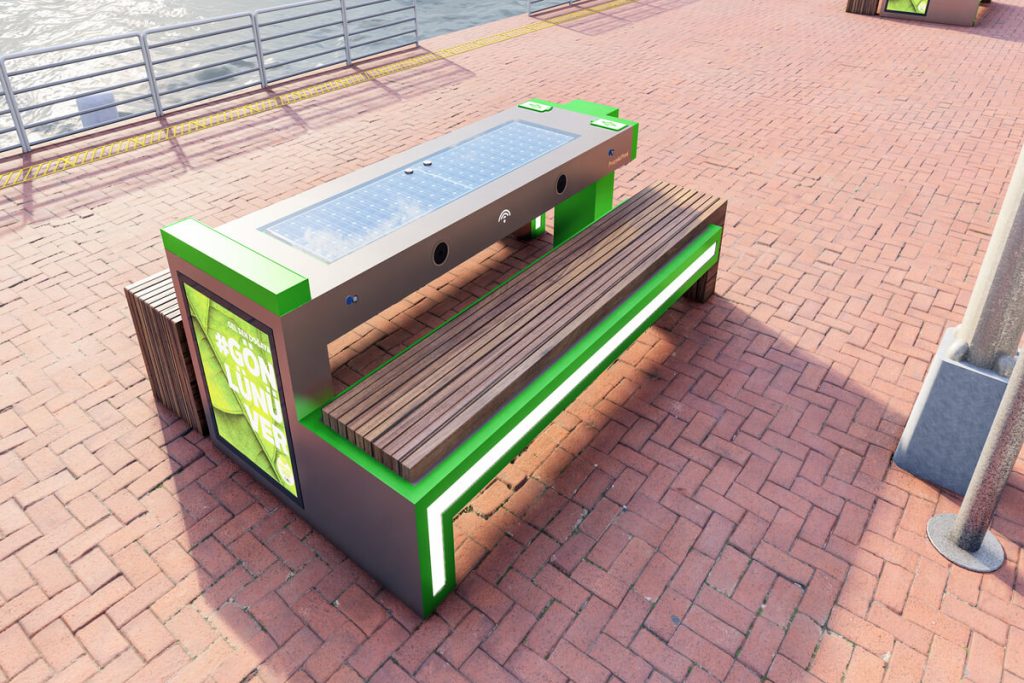
The operating principle of solar-powered urban furniture is not solely dependent on sunny weather. The critical issue here is not energy production, but energy management. These systems consist of three main components: solar panels, energy storage (battery), and a smart energy management unit.
Solar panels don't need direct sunlight; diffused light, which reaches the earth even on cloudy days, into electricity. Of course, the amount of electricity produced decreases, but it doesn't completely disappear. Therefore, solar-powered street furniture continues to generate energy for a large part of the year, not just during the summer months.
The real difference lies in the high-capacity battery systems. In modern solar-powered smart benches, energy generated during the day is stored and used at night or in cloudy weather. This ensures that the systems uninterrupted service .
In solar-powered urban furniture developed by Propysalford, battery capacity based on location, usage intensity, and climate data . This approach ensures that the products not only “work” but are also optimized to suit real-world field conditions.
2. The Reality of Performance in Cold Weather and Winter Months
Contrary to a common misconception, solar power systems can operate more efficiently in cold weather. This is because solar panels experience a loss of efficiency in extreme temperatures, while they perform more stably in cooler weather.
The main challenge during winter months is the reduced daylight hours. However, this can be easily compensated for with proper engineering calculations. High-efficiency monocrystalline panels continue to generate energy even in low light conditions. Furthermore, advanced energy management systems automatically limit unnecessary consumption.
The systems used in Propysalford's smart bank solutions: during the winter months:
- It rearranges charging priorities.
- It uses intelligent charging algorithms to protect battery health.
- It prioritizes critical functions (e.g., USB charging).
Thanks to this, solar-powered urban furniture continental climates, high altitudes , and cold regions . The fact that these products are actively used year-round in many European cities is the clearest proof of this.
3. Working Scenarios in Cloudy, Rainy and Low Light Conditions
Cloudy weather doesn't mean solar-powered street furniture "stops working"; it simply means the energy production rate decreases . The key to the system's success is the balance between energy storage time and consumption .
With substandard or poorly designed products, the system may shut down after a few days. However, professional solutions anticipate this and design accordingly. Propysalford's approach designing for the worst-case scenario .
For example:
- A scenario where there is no sunlight for 3-4 days.
- A park with high user traffic.
- Short days in winter months
By simulating these conditions, battery capacity and panel area are determined. Thus, solar-powered street furniture maintains its functionality not only under “ideal” conditions but also in challenging weather conditions
Furthermore, conditions like rain and snow are generally not a disadvantage for the panels; on the contrary, surface cleaning . With panels installed at the correct slope, snow accumulation is minimized, and the system protects itself.
4. Propysalford's Engineering Approach and the Actual Results
The success of solar-powered urban furniture lies not only in the technology used, but also in how the product is designed . Instead of a "catalog product" approach, Propysalford adopts a use case-focused engineering philosophy in this field
For each project, the following questions are asked:
- How many people will use this product per day?
- In which climate zone will it be located?
- Which functions will remain constantly active?
Based on this data, solar-powered smart benches have been developed that won't let users down. This is what's truly important for municipalities: continuity, reliability, and predictable costs.
In conclusion, well-designed solar-powered urban furniture:
- It works in winter.
- It provides service on cloudy days.
- It is more economical in the long run compared to traditional solutions.
With this approach, Propysalford transforms solar energy from a "marketing argument" a real infrastructure solution .

Frequently Asked Questions (FAQ)
Do solar-powered street furniture systems work on cloudy days?
Yes. Thanks to diffused lighting, energy production continues, and uninterrupted use is ensured by the battery system.
Do solar-powered smart benches shut down in winter?
With properly designed products, no. Thanks to high-capacity batteries and intelligent energy management, they continue to operate.
Does cold weather damage batteries?
With quality batteries and control systems, no. In fact, more stable performance is achieved compared to extreme heat.
Can it be used in every city in Turkey?
Yes. However, the system capacity and panel area must be calculated correctly for each city.
Why do Propysalford's solutions last longer?
Because their products are not standard, but developed through engineering calculations based on real-world use cases.
For more information, please check out our products at: propysalford.com